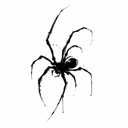
Why the spider?
I owe you an explanation, I think, for the spider.
It sits up there now, next to the clock, taking up more visual real estate than a navigation icon has any business taking. The short version is simple: I've always liked spiders. The long version is really about what it means to make something out of nothing.
People clock the legs first. That's fair, nothing about a spider is trying to be liked. But sit with one long enough while it works, and the flinch quietly turns into something closer to awe. Mine did, anyway.
It builds its own shape
This is the part I've never gotten over. A spider arrives at an empty corner with the entire material of its future project stored inside its own body. No blueprint, no borrowed tools. It just begins. One thread. A second anchor. A line drawn straight through the middle of nowhere. And somehow, given enough patience, the emptiness starts to have architecture in it.
For something so small, that's almost absurd.
My own process is nowhere near that elegant. I open a blank file or a blank page, put down something clumsy and probably wrong, and then just keep tugging at it until it stops being wrong. That's what building software feels like. Writing feels like that too, honestly. You almost never start with the finished shape sitting in your head, you find it by reaching for the next connection and testing, quietly, whether it holds your weight.
That's what creativity is, most days, to me. Not a mood that visits when it feels like it. Not a flourish you add once the real work is done. It's the stubborn, unglamorous act of pulling a shape out of a feeling that, a few hours earlier, you couldn't have described to anyone.
A web ends up beautiful. It also just works. I love that nobody had to choose between the two.
A web notices everything
The spider never has to watch every inch of its own web. A tremor at the far edge still finds its way back through the threads to it. The structure itself carries the news: something has changed.
Maybe that's just the old system-poking part of my brain talking. But I've always been pulled toward this, back when I was learning ethical hacking, I got quietly obsessed with how one small, nearly invisible shift could crack open something enormous hiding underneath it. A server answering slightly wrong. A parameter that flinches when you didn't expect it to. One signal, telling you to stop staring at the obvious surface and follow the thread instead.
I still think that way, about code, about companies, and now about people. What I actually care about is what's underneath the visible outcome. What made someone hesitate. What quietly broke their trust. Which small, unnoticed detail tipped the entire decision sideways.
The web is just a good way of picturing that. Touch it anywhere, and somewhere else already knows.
On all that waiting
Most times I've stopped to watch one, the spider has done very little. I last about ten minutes before the unfinished idea in my head drags me back to work. My brain goes straight to the next build, the next fix, the version after this one. Useful habit, sometimes. Expensive habit too. More than once I've spent hours building around a problem I would've understood if I'd simply left it alone and looked at it.
The spider isn't lazy when it waits. The web is already doing the work of listening. It doesn't need to sprint around performing effort. When the signal finally arrives, it moves faster than you'd think something that patient could move.
I'm trying to learn that difference in myself. Sometimes stillness is procrastination wearing a disguise. Sometimes it's the only form attention takes. From the outside, infuriatingly, they look identical.
Guilty until proven otherwise
There's no PR firm on earth that could rehabilitate the spider's image. People see one and the verdict lands before it's even finished moving: a shoe, a shriek, case closed.
I have a real soft spot for things judged entirely by their outline. Ethical hacking sounds like a crime until someone explains the intent behind it. AI reads as either miracle or menace depending on who's narrating that week. A strange idea looks worthless right up until the exact moment it stops being one.
Being misunderstood doesn't make a thing good, to be clear, plenty of bad ideas are perfectly, correctly understood. But I've stopped trusting snap certainty. The spider just asks for a second look. That's already more patience than most things get.
And then it builds again
The web tears. Sometimes it rains. Sometimes a hand goes straight through it. Sometimes the corner just needs cleaning and that's that. A few seconds later, the work is gone.
And the spider starts another thread.
There's no ceremony in it. No caption about resilience. It just returns to the practical, unromantic problem of putting a web where one used to be. I wish I could say I handle every setback with that kind of quiet efficiency. I don't, not even close. But it helps, having something small and eight-legged around to remind me that's the move.
So, that's the spider, and why it's here. Creativity is most of it, especially the kind that has to earn its keep by actually working. The rest is patience, a stubborn independence, and a certain comfort with being misread.
But underneath all of it, really, it's just about the making. Pull out a thread. Find the one place it can hold. See what it connects to next.
And keep going.